
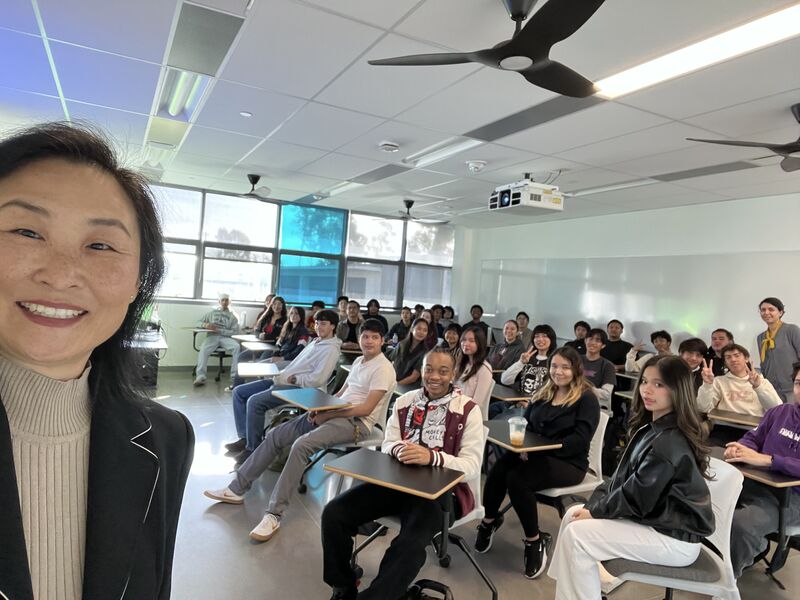
When Dean Jinny Rhee welcomed a room of Long Beach high school students to California State University, Long Beach earlier this year, she knew she wasn’t simply opening a course, she was opening a pathway. “We don’t teach engineering in high school,” Dr. Rhee reflected. Without parents or mentors in STEM, young people often don’t learn what engineering is until college, sometimes too late to pursue it. To address this early access gap, and through planning and coordination made possible by the L.A. Region K-16 Collaborative (Collaborative), CSULB launched Introduction to Engineering (ENGR 101), CSULB’s first-ever dual-enrollment course designed specifically for high school students.
The idea was simple but transformative: give students early, welcoming, hands-on exposure to engineering, even if they weren’t already in STEM pathways. With recruitment support and district coordination facilitated through the K–16 Collaborative, the result was a classroom of students as young as 14 stepping onto a university campus, learning side by side with bachelor’s-level students, and discovering that engineering might be for them after all. The pilot drew 39 sign-ups, and 29 students completed the course and earned CSU credit – a retention rate far higher than anticipated. It was especially encouraging to see that the course cohort’s diversity, measured by student applications and district benchmarks, matched Long Beach’s demographics, of about 17% Black residents – an important step for a college where currently, only 2% of engineering majors are Black. The demographics of the enrollees are captured when they apply for the dual enrollment class, and the Long Beach demographics are easy to find online through multiple sources. As exit surveys showed, the course didn’t just inform students – it changed their sense of possibility. Students overwhelmingly reported increased knowledge about engineering, greater likelihood of pursuing the major, and a stronger interest in applying to CSULB.
Behind that success was the careful, patient and creative instructional work of Dr. Ava Hedayatipour, the faculty member who taught the inaugural ENGR 101 class. When Dr. Rhee first asked her to teach the new dual-enrollment course, Dr. Hedayatipour admits, “My first thought was that this was so out of the norm.” Teaching engineering to students as young as 14–15, alongside bachelor’s students, was new territory. “I knew it was going to be harder,” she said. “Students were coming from different high schools, with different preparation levels. Some had strong extracurricular backgrounds; others had never done a project outside their standard curriculum. But I was determined to make it work.”
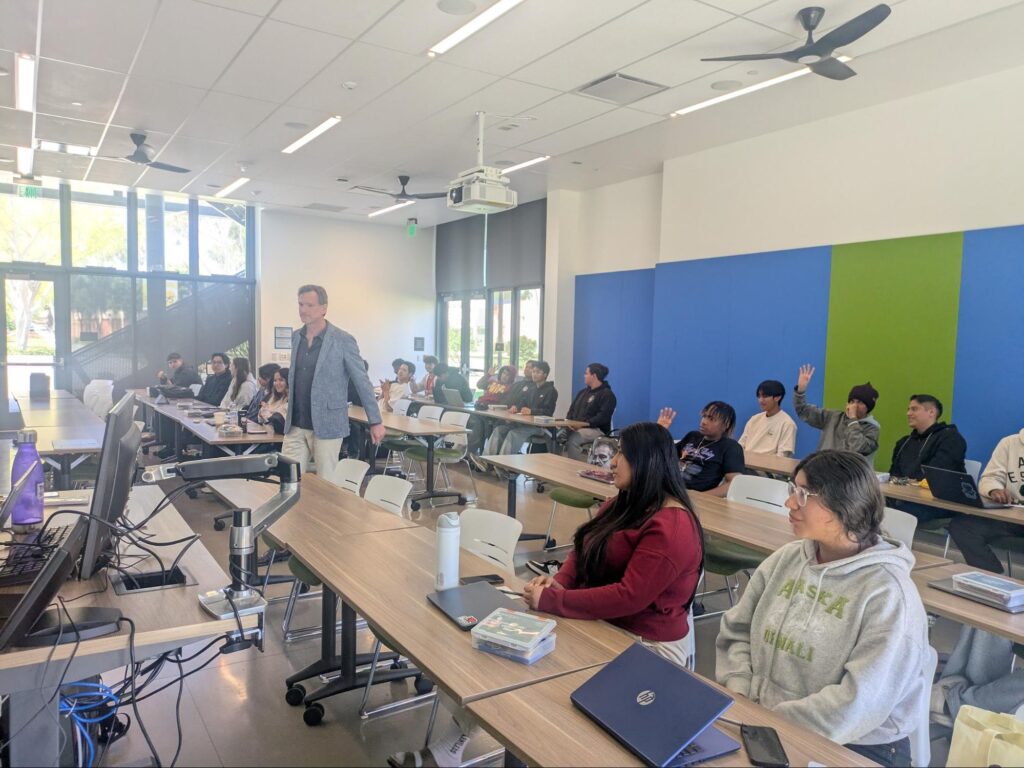
Her biggest decision was one of philosophy: she refused to water down the course. ENGR 101, even at the college level, is a foundational class about engineering fields, research skills, time management, professional development and problem-solving. Dr. Hedayatipour wanted high school students to experience it authentically, but accessible. “I made the lectures much more interactive,” she explained. “Shorter bursts of information. More questions. More demonstrations. More changing the pace of the room.” She incorporated videos, group activities, table discussions and hands-on experiments, and found that younger learners responded incredibly well.
The hands-on portion centered on microcontroller programming using Arduino hardware, a hallmark of CSULB’s engineering education. Here, the high school students surprised even her. “They took the topic and ran with it,” she said. “Debugging is hard – even for college students – but they were persistent. Some even walked around helping my bachelor’s students. I didn’t expect that. It was amazing.” By the end of the course, students completed group engineering presentations, selecting real-world problems and proposing engineering-based solutions. Their work, she said, “was scientific, thoughtful and impressive.” Her biggest takeaway: “I can expect a lot more from high school students than I originally thought.”
For Dr. Hedayatipour, building confidence meant more than simplifying content – it meant clarity. From day one, students received a complete roadmap: session agendas, assignment rubrics, timelines, deliverables and expectations. “I wanted them to feel in control,” she shared. “If you know exactly what the instructor expects and where to find what you need, you feel like you belong.” This clarity, along with the mix of engaging teaching methods, helped students see themselves not as outsiders in a college environment, but as emerging engineers. The biggest challenge, she noted, wasn’t the content – it was simply the class size. With more than 35 students, the instructional demands were “a lot to manage.” Working with high schoolers required a different toolkit, including classroom management strategies she said she learned from teachers on YouTube.
With retention significantly higher than expected, the next phase will involve two smaller sections of about 20 students, allowing more mentoring, tighter pacing and more tailored support. ENGR 101 will expand not only in size but also in scope. While Dr. Hedayatipour will continue teaching a microcontroller-based section, new faculty – potentially from Chemical Engineering and Computer Science – will offer parallel sections focused on Applied Data Science, introducing students to programming, analytics and emerging AI concepts, and Chemical Engineering, highlighting environmental engineering, semiconductor manufacturing, food processing and other modern applications of the field. “No matter which section students choose,” Dr. Hedayatipour emphasized, “they’ll walk away with a real, useful skill – something they can build on their whole lives.”
Both Dr. Rhee and Dr. Hedayatipour are clear: the success of ENGR 101 is inseparable from the structure and habits created through the L.A. Region K–16 Collaborative. “The biggest benefit,” said Dr. Rhee, “is that it forces us to meet regularly.” Key insights, like the fact that LBUSD students choose pathways in 8th grade, only surfaced because partners were in the room together, designing systems collectively. Dr. Hedayatipour echoed this. “I cannot imagine doing this without LBUSD. Their reach is so different from ours. Through the Collaborative, we were able to recruit students from backgrounds we don’t always reach.”
That collaboration didn’t stop at recruitment. LBUSD helped determine the Saturday format, since weekday schedules and after-school commitments made midweek classes impossible. They also advised on meeting frequency, helping CSULB consolidate multiple sessions into fewer, longer blocks, removing barriers for families. Perhaps the most important impact is how the collaborative work sparked deeper alignment across institutions. “While we collaborated on ENGR 101,” Dr. Hedayatipour shared, “other departments at LBCC and CSULB started reviewing articulation agreements. Now we’re strengthening many more course equivalencies, far beyond the original grant.” The work has already created a blueprint the college plans to replicate with other community colleges and potentially with other K–12 districts like LAUSD.
For both Dr. Rhee and Dr. Hedayatipour, the rationale is clear. If students only learn about engineering at 18 or 19, the pipeline has already narrowed. “The U.S. workforce needs more engineers,” Dr. Hedayatipour said. “But the journey doesn’t start at the university. It starts in K–12.” Dual-enrollment engineering courses are a way to meet students earlier, directly addressing the perception that engineering is “only for the top 1%” or for students naturally gifted in math. “It’s not true,” she said. “Engineering is a curve. You learn it step by step. Anyone who’s curious, persistent and supported can become an engineer.”
That is exactly what ENGR 101 is providing: curiosity, persistence and support, years before most students ever enter a lecture hall. Both Dr. Rhee and Dr. Hedayatipour imagine a future where ENGR 101 becomes a regular, sustainable offering through CSULB, with expanded sections, smoother pipelines and partnerships across districts. With four years of Collaborative work behind them, they see the foundation clearly. “When students come onto your campus and meet engineers, something shifts,” Dr. Rhee said. “They start to picture themselves here. And when they can picture themselves here, everything changes.” For the students of Long Beach, that shift has already begun – with tools in hand, college credit in their pockets, and the growing belief that engineering is not just an abstract idea or someone else’s dream, but a real future they can claim.

ABOUT THE CAL STATE UNIVERSITY, LONG BEACH COLLEGE OF ENGINEERING
The CSULB College of Engineering is committed to expanding access to high-quality STEM education and preparing a diverse generation of engineers to meet the region’s workforce needs. Through innovative programs like ENGR 101 dual enrollment, industry-aligned curricula, and strong partnerships with K–12 districts and community colleges, the college empowers students to explore engineering early, build confidence, and advance along equitable pathways into high-demand fields across Los Angeles and beyond.

ABOUT THE L.A. REGION K-16 COLLABORATIVE
The L.A. Region K-16 Collaborative is closing racial and gender gaps in postsecondary attainment and employment by building equitable pathways to careers in healthcare, engineering and computer science. The collaborative is leveraging existing initiatives and relationships across L.A. County, uniting higher education segments and institutions, K-12 districts and schools, employers and business organizations, local government and community partners to amplify our collective impact on equitable degree attainment.