
 This summer, the Project CAMINOS STEM Summer Academy at Cal Poly Pomona (CPP) welcomed high school students from across Los Angeles for a week of hands-on STEM exploration. Project CAMINOS, now in its sixth year, has been supported by the L.A. Region K-16 Collaborative since 2023. Both initiatives aim to expand college access, persistence and degree completion in computer science and engineering and particularly for women-identifying students, who make up roughly 20% of students enrolled in those programs.
The Academy has introduced students to hands-on learning experiences ranging from robotics to architecture. The aim of the week-long immersion program is to show students, many visiting CPP for the first time, that a university education is not just possible, but within their reach. Through Project CAMINOS, education and STEM pathways are made accessible to students and create opportunities leading to degree completion and career exposure.
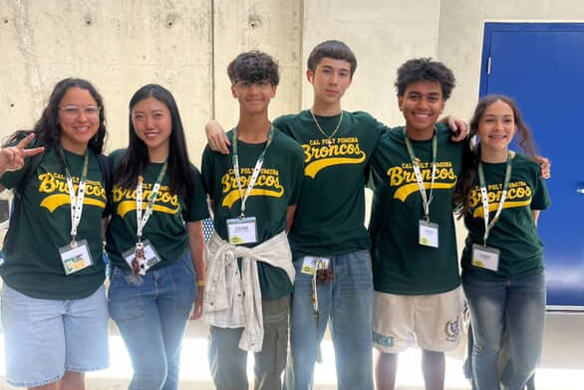
This year, thanks to targeted outreach focused on increasing female participation, Project CAMINOS yielded 21 female-identifying registrants out of a total 32. While the Academy prioritizes students from the Pomona Unified School District, it is open to CPP’s local service area. Project CAMINOS welcomed 11 ninth graders in summer 2025, three 10th graders, eight 11th graders, and ten 12th graders representing districts in Pomona, Alta Loma, Azusa, Chaffey, Covina, Rowland and Upland.

Judi Quintero, the Outreach coordinator for Project CAMINOS noted, “Without [L.A. Region K-16 Collaborative] funding, we wouldn’t be able to put on a fleshed-out program.” Quintero also said she wishes they could offer a similar experience to more students, especially those who don’t consider CPP their first choice, “It’s not until they get on campus that they get to see what we have to offer.”
For Dr. Jessica Perez, who teaches first-year engineering courses, the week was about more than just orientation and exposure to labs and programs. “Engineering is iterative. Learning is about growth, not a static process. We wanted students to walk away knowing that everyone is an engineer, what matters is the perspective you bring and the questions you ask.”
Student participants echoed this message. One sharing, “I was interested in engineering, but hadn’t considered CPP’s College of Engineering until now.” Another added, “At first, I was worried about my fit. But this week has been great to get to know other students. Everyone’s been nice, and it’s been really fun.”
The Academy also opened its doors to ninth graders for the first time this summer. Quintero admitted that there were initial concerns, but were quelled by week’s end. “This year, with strong support in place, we moved forward [to offer ninth graders spots], and it has been wonderful. Older students are stepping into leadership roles, younger students are inspired by their peers, and together we’re all seeing new possibilities unfold.”
 Daisy Ayala-Aguilar, a third-year architecture student and Project CAMINOS student ambassador, served as a relatable peer voice and played a key role in connecting CPP to the high school students. “It’s one thing to hear from alumni, but it’s another thing for high schoolers to ask a current student about everyday life. ‘Where do you like to eat?’ ‘How do you get around campus?’” Daisy shared relatable stories, like how she first chose architecture “on a whim” and discovered it as human-centered design, balancing beauty, function and accessibility.
Through the Project CAMINOS STEM Summer Academy, Cal Poly Pomona is not only opening doors to higher education, they’re ensuring students see themselves walking through them. From learning about Collins College of Hospitality Management’s student-run restaurant and hotels to the hands-on act of merging art and technology at the campus Maker’s Studio, the Academy offered students a vision of themselves as active learners. As Judi reflected, “Students often decide if a campus is a good fit within the first few minutes. It’s amazing to watch their perspectives change in just one week.”
Families of participants also played a crucial role in Project CAMINOS. Students’ guardians received updates, photos and schedules, helping build trust and a sense of inclusion over the five-day experience. Many expressed how grateful they were to see their children not only exploring academic opportunities but also developing independence and confidence on a university campus. Said one parent, “My daughter, Gaby, had an amazing time. She learned a lot, made some new friends, and is really excited about moving forward in her educational journey. That is a lot to say for an incoming ninth grader!”
Xiomara Melendez, the senior coordinator of Early Academic Engagement in CPP’s Division of Academic Affairs, noted the program has become a trusted partner in the region and plays an important role in showing students that they belong at Cal Poly Pomona. She adds, “Thanks to the support of the L.A. Regional K-16 Collaborative, Project CAMINOS will continue its mission to expand college access and success for students and families beyond the [initial funding from the] U.S. Department of Education Title V Hispanic Serving Institution grant.” In alignment with the goals of the L.A. Region K-16 Collaborative, “This year’s increase in female participation reflects our shared commitment to equity in STEM, and we’re hearing from students that they leave feeling comfortable in our classrooms, confident in our labs, and connected to a community that’s ready to welcome them. That’s the heart of this work, opening doors and making sure students see themselves walking through with confidence, community and purpose.”
Learn more about Project CAMINOS here. For more information on the Summer Academy, please contact Project CAMINOS at caminos@cpp.edu or 909.869.3714.

ABOUT PROJECT CAMINOS
Project CAMINOS was established in 2019 through a U.S. Department of Education Title V Hispanic Serving Institute (HSI) grant. The program is dedicated to eliminating the equity gap by preparing underrepresented students for success and graduation through outreach, advising and faculty development. The initiative is led by CPP Provost Dr. Terri Gomez and Associate Vice President of Student Success Dr. Cecilia Santiago-Gonzalez, and is coordinated by Xiomara Melendez and Judi Quintero.

ABOUT THE L.A. REGION K-16 COLLABORATIVE
The L.A. Region K-16 Collaborative is closing racial and gender gaps in postsecondary attainment and employment by building equitable pathways to careers in healthcare, engineering and computer science. The collaborative is leveraging existing initiatives and relationships across L.A. County, uniting higher education segments and institutions, K-12 districts and schools, employers and business organizations, local government and community partners to amplify our collective impact on equitable degree attainment.